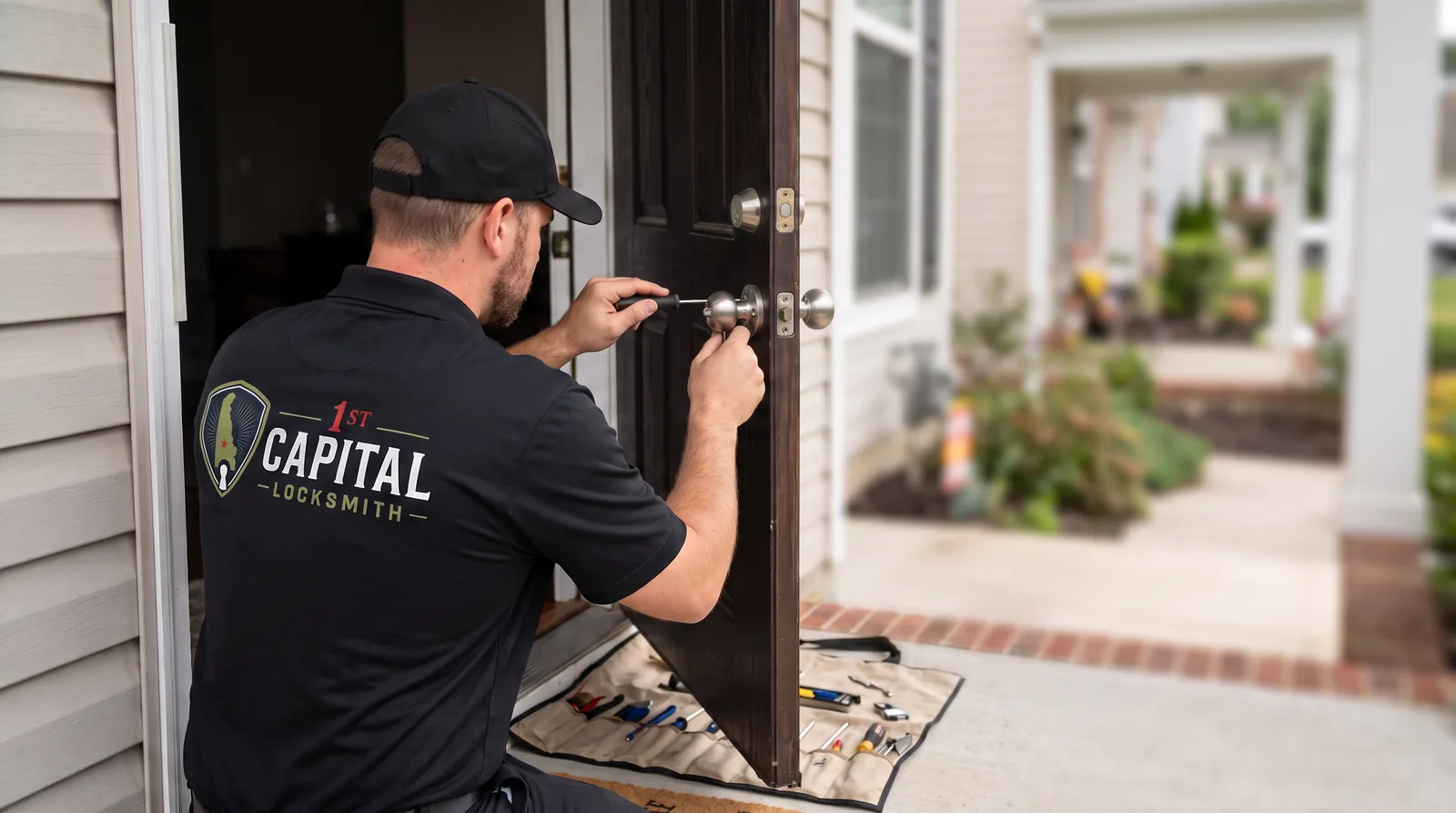
Your deadbolt sticks, or the key turns hard, or the door just won't latch. Now you're trying to decide whether to repair or replace a door lock in Dover, DE, and every answer online says "it depends." A plainer rule works better. Repair a worn part or an alignment problem. Replace a lock that's cracked, corroded, or keeps failing after a fix.
Before you decide, check one thing. Some "broken locks" are really door problems: the lock is fine, but the door has shifted and the bolt can't line up with the frame. Below you'll find a quick test, a symptom table, and a note on when rekeying beats both.
Key Takeaways
- If a lock sticks only when the door is closed, suspect door alignment, not the lock.
- Try graphite, snug hinge screws, and a strike plate adjustment first.
- Repair one worn part on a sound lock. Replace a lock that's cracked, rusted, or failing again.
- Rekey when the real issue is who has keys.
In short: The Door-Open Test separates a failing lock from a misaligned door. Work the deadbolt with the door open, then closed. If it moves freely open but binds shut, the problem is usually alignment between the bolt and strike plate, not the lock. Hunker names that misalignment as a cause of sticking.
You can tell in about two minutes, and the steps below show how.
What is the Door-Open Test? The Door-Open Test is a three-step check that separates a failing lock from a misaligned door. You work the bolt with the door open, then closed, then look at where the bolt meets the strike plate. Whether the trouble shows up with the door open or only closed tells you where to look.
Doors can swell and shift with the seasons, and hinge screws loosen with daily use. A shift you can barely see is enough to stop a bolt from sliding into its hole. If the test points at the lock itself, a lock repair in Dover visit can tell you whether a part is worn or the whole lock is done.
In short: Three small fixes often help a sticky deadbolt: a puff of powdered graphite in the keyway, snug hinge screws, and a small strike plate adjustment. Eufy advises graphite-based lubricant over oil-based products, which attract dirt. Stop if the key grinds, since forcing it can snap the key off inside the lock.
Home-repair sources such as This Old House walk through realigning a dead bolt and strike plate step by step.
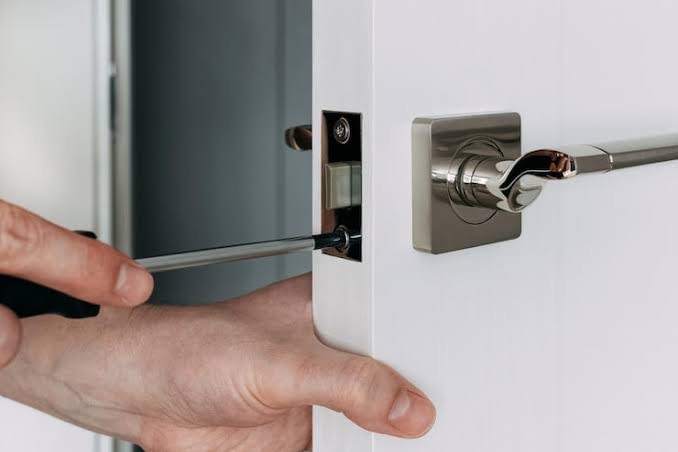
Puff powdered graphite into the keyway and work the key in and out a few times. Skip oil-based lubricants there. They attract dirt, and grit makes the turn worse.
Check each hinge screw with a screwdriver, starting at the top hinge, where the door's weight pulls hardest. A door that sags a little can drop the bolt below the opening in the frame. If a screw just spins, the wood is stripped. A longer screw can sometimes bite on a hinge, but it won't fix a worn lock.
If the bolt hits the edge of the opening, loosen the plate, nudge it toward where the bolt lands, and retighten. Move it a hair at a time, closing the door and trying the bolt after each nudge.
Stop if the key grinds as you turn it or the knob wobbles on its screws. A key forced past that point can snap off in the cylinder, and then you're facing a key extraction.
In short: Repair a lock when one part is worn or loose and the rest is sound: loose handle screws, a dirty cylinder, or an out-of-line strike plate. If the same fault returns after a fix, the mechanism is likely worn throughout, and replacement usually beats a third repair.
Locksmiths do disagree on edge cases, as a Locksmith Ledger column on repair versus replace shows. So we keep the rule simple: fix the part, not the whole lock.
The catch is repeat failures. If the same fault comes back a second time, treat that as a signal.
One of our technicians told us about a sticking-deadbolt call in Dover. The homeowner had already sprayed lubricant into the keyway, and it hadn't helped. The technician found the mounting screws just spinning in their holes, because the screw holes in the door were stripped out. The old lock was worn too, so tightening the screws wasn't going to hold.
They replaced the lock. Loose screws are a repair when the wood still grips them. When the holes are gone and the lock is worn, repair stops making sense.
If the lock is still solid and one thing is off, our lock repair service is the place to start.
In short: Replace a lock when the damage is inside the lock itself: cracked or bent parts, internal corrosion, a bolt that will not extend, or a key that still sticks after graphite. Age alone is not a reason. Condition and repeat failure decide it.
A deadbolt with a broken tailpiece, the small bar on the back of the cylinder that turns the bolt mechanism, is a gray area. In an informal reader poll, Locksmith Ledger found that most locksmiths would replace the whole deadbolt, while a few would swap only the cylinder or tailpiece. We lean toward replacing when the lock has failed before.
Replacement can also be a security upgrade. Our lock change service swaps a worn lock, and a deadbolt installation adds one where there isn't a good one. Need help choosing? See our guide to the best door locks for your home.
Match your symptom to the likely cause, then pick the fix. Alignment trouble, loose parts, and dirty cylinders call for repair. Cracks, corrosion, and repeat failures call for replacement. If the lock works but keys are the worry, rekey.
| Symptom | Likely cause | Best fix | Why |
|---|---|---|---|
| Deadbolt sticks only when the door is closed | Door or strike plate alignment | Repair | The lock works. The fit is off. |
| Key and bolt stiff even with the door open | Dry or dirty cylinder, or worn internals | Repair first, replace if graphite fails | Try the gentle fix, then judge. |
| Loose knob, handle, or trim | Loose or stripped screws | Repair, if the lock is otherwise sound | One small part. If the holes are stripped and the lock is worn, replace. |
| Key turns but the bolt doesn't move | Broken tailpiece or internal part | Repair or replace | Locksmiths differ. Past failures tip it to replace. |
| Cracked, bent, or broken parts | Physical damage | Replace | Damaged hardware won't hold up. |
| Rust or corrosion inside the lock | Wear from weather and time | Replace | Corroded internals rarely recover. |
| Same problem returns after a fix | Worn mechanism | Replace | Repeat failure is the signal. |
| Lock works, but keys are unaccounted for | Key control, not wear | Rekey | New keys, same hardware. |
Use the table as a starting point. Two locks with the same symptom can need different fixes.
In short: Rekey instead of replacing when the lock works but key control is the concern. Rekeying changes the internal pins so old keys stop working while the hardware stays on the door. It suits a new home, a lost key, or a former tenant, but it will not repair a worn lock.
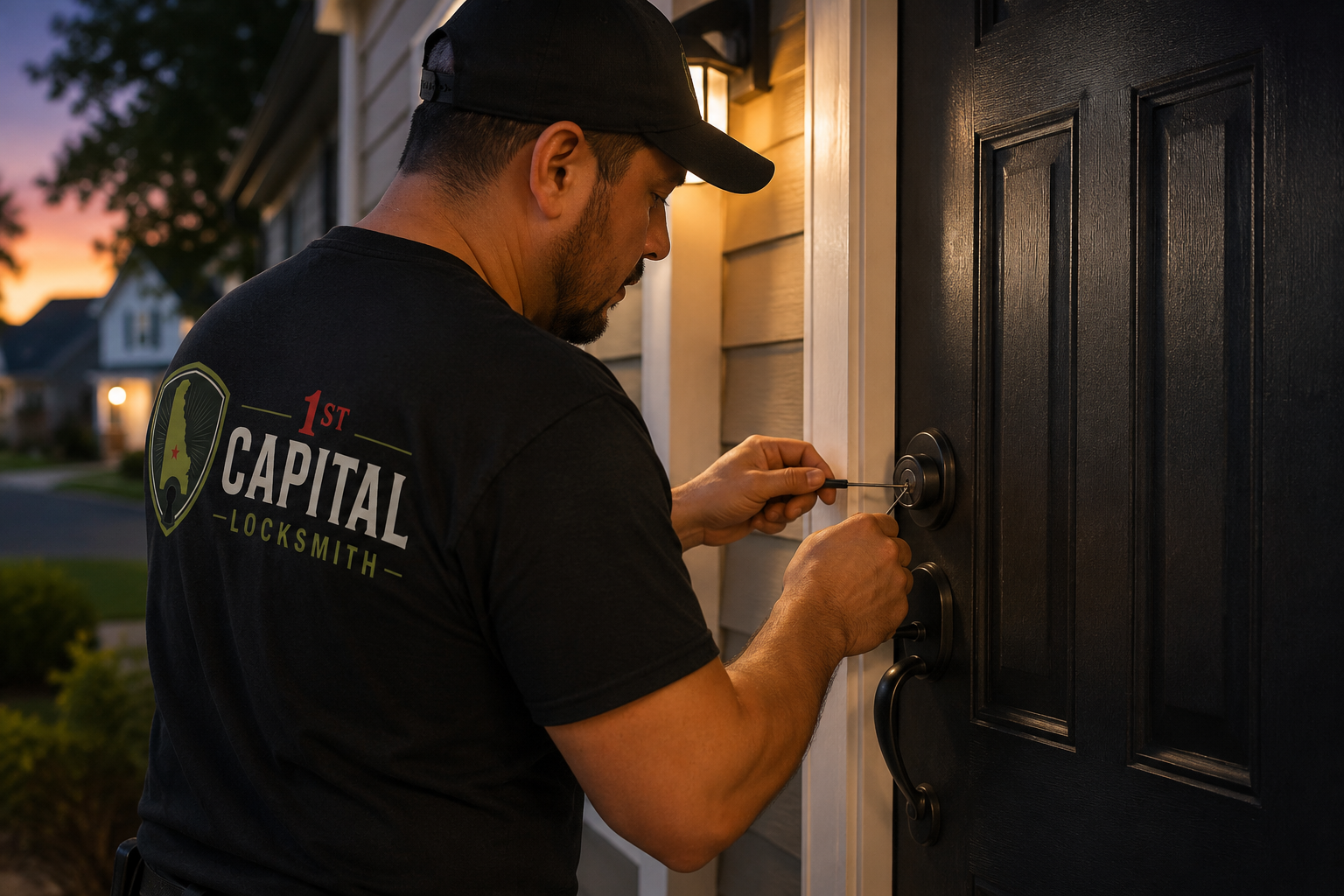
Think of it this way. If your problem is "this lock won't work," you're in repair or replace territory. If it's "too many people might have a key," that's rekey territory.
“The technician was amazing. Called this morning and he was here same day to replace my knob and rekey. He was quick under 8 minutes. Thank you everything”
Terrance M., 5-star Google review, September 2026
For timing, see how often to rekey your home locks. When you're ready, our lock rekeying service handles it on site.
Call a locksmith when quick fixes fail, parts are broken, or security is at stake. A key snapped off in the cylinder, a bolt that won't move, or damage after a break-in are all good reasons. A repeat failure is another good reason. We come to you and explain what needs doing and why before we start.
A working lock matters because many break-ins need no force. Delaware's Statistical Analysis Center counted 301 reported burglaries in Kent County in 2024, and 149 of them were unlawful entries with no force (Crime in Delaware, 2020-2024). That's about half. A sticky lock is easy to stop using, and a lock nobody uses protects nothing.
We're a bonded and insured, locally owned and operated mobile locksmith. We serve Dover, DE and nearby towns, including Camden, Felton, Magnolia, Harrington, and Frederica. Call (302) 735-0050 and describe what's happening. A photo of the lock and the edge of the door helps.
Outside Dover, we also repair locks in Felton and Milford.
Start with the Door-Open Test, then try graphite, hinge screws, and a strike plate nudge. Repair a sound lock with one worn part. Replace a lock that's cracked, corroded, or failing again. Rekey when the question is who holds the keys.
If you're still not sure, call 1st Capital Locksmith at (302) 735-0050. We'll look at the lock and the door and tell you what we'd do.
Repair it when one part is worn or the door is out of line. Replace it when the lock is cracked, corroded, or has failed more than once. Run the Door-Open Test first, because a sticking lock is often a door alignment problem. If you can't tell, a locksmith can check both quickly.
A hard-turning deadbolt points to a dry or dirty cylinder, a misaligned door, or a worn part. Try the Door-Open Test. If it turns easily with the door open, check the strike plate and hinges. If it's stiff even then, try powdered graphite, then call a locksmith.
The bolt isn't lining up with the hole in the frame. Home-repair guides like Hunker point to a deadbolt that is out of line with the strike plate. Tighten the hinge screws, look for scuffs on the strike plate, and adjust it slightly. If the lock works with the door open, the problem is the door, not the lock.
Often, yes, if the damage is limited to one part and the rest of the lock is sound. A loose handle, a dirty cylinder, or a misaligned strike can all be fixed. If parts are cracked, the bolt won't engage, or the same fault keeps returning, replace it.
It depends on the problem. Rekey when the lock works but you want old keys to stop working, such as after a move or a lost key. Replace when the lock itself is damaged or worn out. Rekeying changes who can open the lock. It doesn't repair a failing one.
Call 1st Capital Locksmith or request a visit and tell us what you're seeing. We'll explain what needs doing and why before we start.
Helpful Internal Links
Need the service behind the article? Visit residential locksmith services, automotive locksmith services, or commercial locksmith services. For local coverage, review our service areas or reach out directly.
Local coverage pages you may want next: Dover, Smyrna, Milford, Camden, and the full service areas directory.